Cloud Computing: How It Works, Benefits and Types
Cloud Computing: How It Works, Benefits, and Why It Matters
Cloud computing has transformed how data and software are used and stored as well as how users access digital services. Cloud computing moves the onus of sophisticated and expensive infrastructure onto the service provider; the end user only needs an internet connection to access cloud computing resources.
In the past decade, cloud computing has become essential to modern technologies and services from personal to enterprise use.
What Is Cloud Computing?
Cloud computing is the use of the internet to provide computing services. These services can include storage, computers, databases, networking, software, and processing.
Rather than buying and maintaining infrastructure, organizations can hire cloud services from a cloud services provider.
One of the most common cloud services in use today is cloud storage. Cloud storage services help users store files in the provider’s “cloud” and access them from any device. Enterprise cloud services can help users host web pages, manage databases, run software, and analytics.
Types of Cloud Computing
There are different types of this technology models include public, private, hybrid, and community clouds.
Public Cloud services use the multi-tenant model, meaning a cloud provider provides cloud services to many customers using the same hardware. This model benefits customers looking for low-cost flexibility without a large capital expenditure and no responsibility for the hardware.
Private Cloud services are single-tenant cloud services, meaning a customer is the only tenant, and is often used to meet specific security and operational control needs.
Hybrid Clouds allow a mix of public and private clouds. This is particularly useful where the security or business requirements dictate that some workloads be kept on-premises.
Cloud Services are categorized in different ways. In this example, we are separating them by what the customer receives.
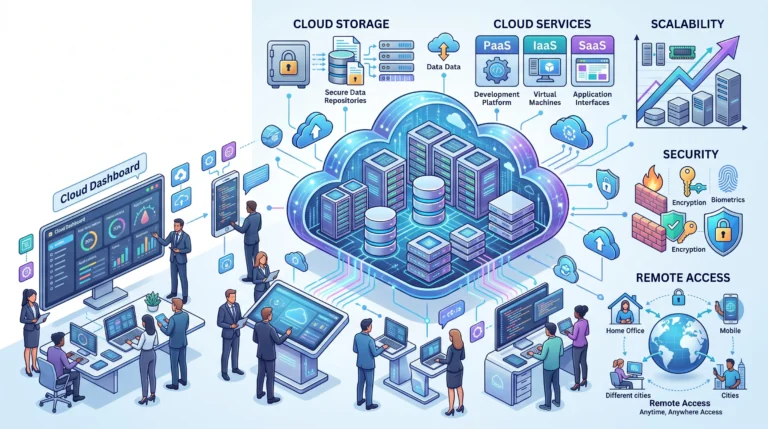
Infrastructure as a Service (IaaS) provides virtual servers and storage.
Platform as a Service (PaaS) provides an environment for development and deployment of applications.
Software as a Service (SaaS) provides access to software applications. In this context, a service is a cloud computing resource.
Benefits
One of the advantages of cloud technology is scalability. Cloud resources can be added or removed as needed by users throughout the process. Companies do not need to physically manage the supported resources like before.
It relies on external service providers. Companies do not need to purchase and manage large hardware resources. Instead of purchasing a massive data center, companies can use cloud computing. Cloud computing does not require companies to manage hardware from multiple locations. Files can be shared through the internet.
It is useful for company collaboration. Users can work simultaneously on the same documents and files without being in the same office. Cloud computing allows businesses to maintain backup and recovery resources of lost data and systems. In the presence of a failure of physical resources, cloud computing can ensure business continuity.
Cloud computing has many advantages. However, for a business to move resources to the cloud, there are challenges around security, privacy, compliance, and costs of redundant cloud infrastructure.
Importance in Home and Work Life
Cloud services are utilized extensively in day-to-day applications and services. Email, file storage, video streaming, meetings, chats, and mobile applications use cloud services.
Cloud services provide website hosting, customer service management, analytics, and software development. Cloud services also provide file storage and collaboration tools.
Cloud technologies must be utilized to support computational and storage-intensive tools including artificial intelligence and machine learning.
Security should be a top priority for cloud services. Organizations must use multiple authentication layers, access control lists, encryption, constant monitoring, and periodic security reviews.
Cloud services provide a variety of features. Security and sophisticated access control systems must be prioritized.
Final Thoughts
Cloud technology creates a flexible on-demand computing infrastructure that supports the digital transformation of personal and business computing needs.
Cloud technology helps businesses innovate by empowering them to concentrate on their core business instead of the underlying IT infrastructure. It is security conscious, has costs that can be anticipated to some extent and can be adjusted to fit operational demands, and can be easily customized to meet various business needs.
Cloud technology has various use cases, and its potential will grow alongside the integration of software-enabled services. Knowing cloud computing will help people and businesses identify and utilize technology appropriately based on changing needs.
Frequently Asked Questions
What is cloud computing?
Using resources such as storage and processing, software and servers, through the internet instead of through local hardware, is cloud computing.
What are main cloud computing options?
Cloud types include public, private, and hybrid. Services are also classified as IaaS, PaaS, SaaS.
What are the advantages?
Some advantages includes an easier ability to scale, more accessibility, flexibility, and increased collaboration, while more dependence on services instead of physical tools.
Is cloud computing safe?
Correctly implementing security controls makes cloud computing safe. Users must take into account authentication, permissions, encryption, monitoring, and even compliance.
Why is cloud computing valuable?
It supports a multitude of valuable services and resources in modern business and offers flexible technology understanding.